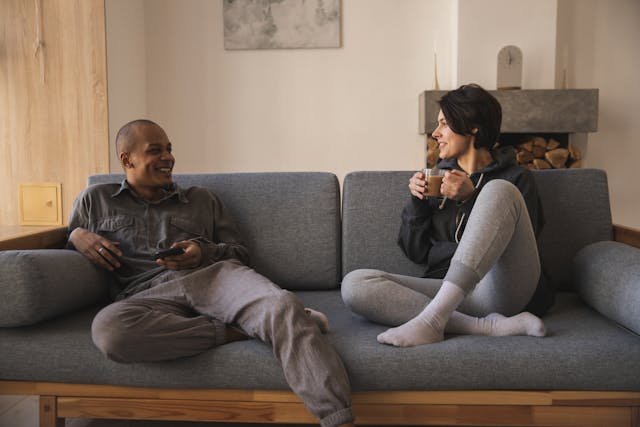
A common problem couples in therapy is the difficulty of deescalating conflict. They often “trigger” each other and then, confessing that they’re both be too “stubborn” to let go of righteous anger, the fighting continues until they walk away angry, after saying things they later regret. I don’t work with couples where there’s been physical abuse. But verbal abuse is not uncommon, and they’ve often hurt and offended one another enough to have formed strong feelings of resentment, which are reawakened and renewed in each new fight.
Conflict: What’s the Root of the Problem?
Here’s what they say: They need to learn how to communicate differently. They complain about not being heard and respected. As emotions intensity and regulation of emotion fails, one or both may resort to yelling and name-calling. We can agree that such behavior is destructive and needs to stop. Each partner can cite a list of unacceptable behaviors performed the other, but doing so is not a solution. They arrive expecting that there are skills they might learn to change all this.
Many, including professionals, assume that couples therapy is mostly about skill-building in communications. But that’s not been my experience. Then perhaps, we may muse, it’s about changes in attitude and in behavioral routines or if/then strategies. Alas, I’ve found that trying to go directly to these kinds of change is not usually enough. These approaches assume a readiness that most often does not exist. For by the time they’ve come to see me, their attitudes have hardened, their problems have “aged.”
They’re armed and ready to defend themselves. They know their enemy. You might think I sound cavalier or pessimistic. Quite the contrary. I respect the reality and power of this mental state. It’s rooted in an attitude that is shaped by witnessing the chronic, cause-effect pattern of their behavior over time. Their chronic fighting has changed them, it has created a distance, and it has caused them to see one another and themselves differently. It won’t change by flipping a switch; a new reality must arise.
Creating a New Reality
Chronic conflict changes us. It’s not irreversible, but it stabilizes into a set of beliefs and expectancies, which must be disconfirmed before they can be set aside in favor of a new attitude and more positive behaviors. What’s paradoxical in this is that couples often see their fighting stance as an assertive claim of freedom, yet the negativity of the chronic cycle of conflict leaves them less free. Being immersed in the battle, they are not able to see how their habits enslave them, limit their choices.
Chronicity – 1) continuing or occurring again and again for a long time; 2) constantly vexing, weakening, or troubling; and 3) being such habitually. (Merriam-Webster)
No doubt, the secret hope of some who present for couples therapy is that they’ll be vindicated. But I think there is also somewhere within them the knowledge (and the fear) that somehow they’ve gotten it terribly wrong and that unless things change they may lose what they thought they had. Stubborn and scared. The former indicates a need for fresh perspective, the latter a need for emotional safety. Both are needed, and they’ll only be found if the therapist is credible, candid, and trustworthy.
Creating a new reality, one that disconfirms their present state and the beliefs and assumptions that underlie it, requires data, objectivity, and suspension of judgment. These conditions are not possible outside the consulting room at first, but I can “demand” them here. This is my space, and I’m not here to host their fighting. With credibility and sincerity, I can challenge them look at what they are doing, what is really happening, and how they are systematically sustaining what they currently have.
Assessment and Interpretation
Psychology is distinctive as a discipline in many ways, but a primary feature that differentiates it from other therapeutic disciplines is its use of assessment. I won’t go into technical details here, but I will say it is what most qualifies my clinical discipline as a science. It’s not a pure or hard science that studies things, but a human science that seeks to understand persons, personality, and interpersonal dynamics. And what most differentiates this science from others is it reliance upon interpretation.
Psychological assessment data, at their best, are rich and relevant stimuli for reflection. In reflection, we, the client/s and I, look for the meaning of these data for them, their situation, for the behavior and context that characterize their presenting problems. Interpretation first explores possibilities. Then it looks for practical relevance. We do it jointly. I describe what the assessment tool measures and offer impressions of what the results might mean for them, hypotheses of how this explains their behavior.
I do this to transform psychological science into the working material of clinical engagement. I tell the client/s “Neither or accept nor reject anything I have to say too quickly; rather, consider it, and ask, how might this be relevant for me?” Even if only temporarily, curiosity replaces judgment, freeing them to see one another and their situation afresh. We consider how their differences (in personality or interpersonal style) play a role in explaining how they get stuck, misunderstand one another, and how they might get unstuck from chronic cycles of conflict.
Dignity and the Potential for Change
We recognize the dignity of each person, who they are, how they are different, and how it is possible to misinterpret one another. Dignity is experienced when we to see ourselves and one another as persons, each having value and deserving of being treated with respect. We come to see ourselves and our partner as free agents. We experience life from distinct centers of consciousness. We were raised in different homes, shaped by different norms for how differences are expressed and resolved.
Interpretation as described above takes us to a highly individualized sort of meaning and relevance of the assessment data for you, your partner, your patterns of interaction, and how these considerations might explain the way you get triggered and respond to one another. Each person wants to be seen, heard, and feel safe from attack. We recognize our fallibility and how important it is to express our fears rather than hiding them in acts of aggression and anger. For that is false, at best a partial truth; it does not tell the whole story.
We want our most intimate other, above all, to be a special friend, someone who’s got our back. This quality of trust, formed when we first met, evolved into unconditional love. But it’s an achievement, not secured for all time. It needs maintenance. For many things happen in life. Work and family, new roles, responsibilities and challenges. It’s easy to assume that the best of who are and what we have will always be there for us. But it’s not, at least not without effort, effort encouraged by friendship.
Friendship Restores Love
First we were friends. Then we became special friends, so special that we chose to make an exclusive commitment to share a life together. Love is a bond of emotional intimacy that grows out of friendship as it becomes unique and special. It’s a fullness of affection when in full bloom, but it can also rests in a less manifest but abiding way in the background of life as we undertake the demands of day-to-day living. And when life demands peak for too long it can almost seem to disappear or atrophy.
We must see this change as it happens, observe the suffering, strain, and pain in our significant other’s eyes, voice, and posture. Fatigue makes even the simplest tasks of life feel daunting. We can feel fated to a life that leaves us feeling less loved, less worthy of love, and less special. But we must recognize that this is not fate but fear, fear that we don’t have the answers. It’s a sign that we need a friend, a special friend to help us, perhaps initially to just hold us. There is something to be seen, learn, and renewed!
I cannot make all this happen for a couple. But I can help couples find again the capacity to be friends and to see their lives as a shared journey. From there, it’s been my experience that any skill building and practical changes they might need can more easily be recognized and learned. We can apply fitting life practices to the areas of life that need attention. Expectations and priorities must change with the circumstance of life. Then love can bloom again more frequently.